







Wedding Invitation Wording

Which invitation text best reflects your wedding? A couple often wants a beautiful invitation, but does not always know whether to choose a formal, short, cheerful, themed or completely modern tone. The problem is that a beautiful phrase alone does not make an invitation good. Wedding invitation text must match the couple’s personality, the guest audience, the celebration’s atmosphere and the chosen format.
Regardless of style, guests must clearly find the couple’s names, the date, the time of the ceremony and celebration, the venue, and the contact or deadline for replying to the invitation. Lithuanian wedding planning guides also recommend stating, depending on the situation, the dress code, gift wishes, accommodation information or a plan for the second day.
The eight wedding invitation text styles below will help you choose a direction rather than blindly copy a template. For each one you will find who it suits, what to avoid, and how to close the invitation with specific RSVP information.
Contents
- 1. Classic formal wedding invitation
- 2. Modern minimal invitation
- 3. Personalised and humorous invitation
- 4. Adventurous and themed invitation
- 5. Digital or electronic invitation
- 6. Traditional Lithuanian or sacred tradition invitation
- 7. Photo and nostalgic invitation
- 8. Eco-friendly or minimalist green invitation
- Comparison of 8 wedding invitation texts
- From a beautiful phrase to a clear invitation
1. Classic formal wedding invitation
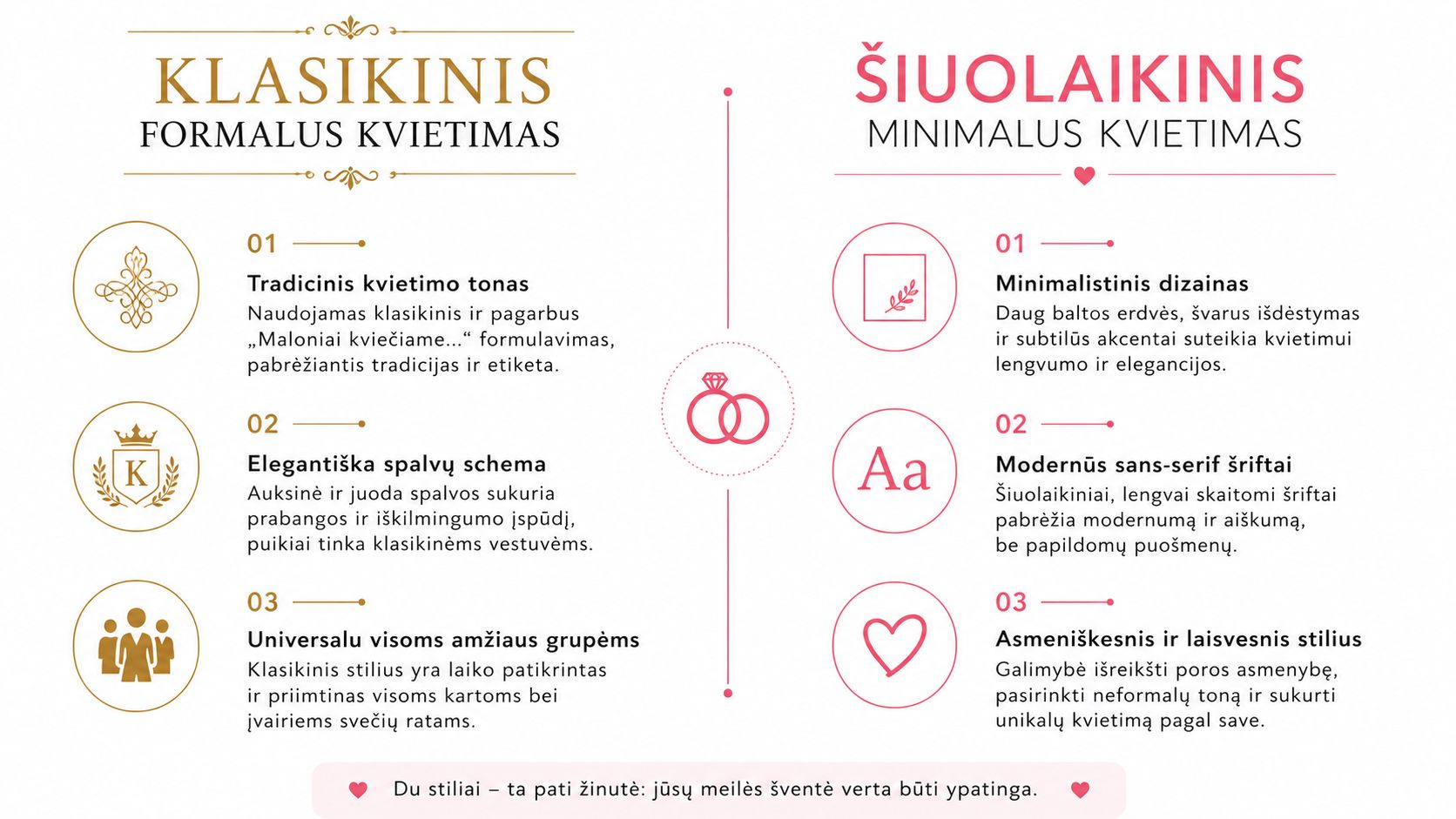
The classic text suits a couple planning an elegant wedding inspired by traditional etiquette. It is especially convenient when the guest list includes people of different generations, including parents, grandparents, older relatives and family friends. A formal tone leaves no doubt about the kind of celebration to expect.
In Lithuanian wedding tradition the celebration was historically understood as part of a wider ritual cycle, covering matchmaking, the wedding and the homecoming. At the end of the 19th and the beginning of the 20th century these stages had clear ritual elements, so the invitation worked not only as information but also as an invitation to a community celebration (Lithuanian National Centre of Culture).
Sample text
We warmly invite You to our wedding ceremony.
[Groom’s name] and [bride’s name]
will marry on [date] [time]
[ceremony venue].After the ceremony we will be waiting for You at [celebration venue], where we will celebrate this special day together.
Please let us know about your attendance by [date] by phone [number] or by email [address].
When writing a formal invitation it is important to choose a polite form of address, consistent punctuation and a clear sequence of information. Avoid overly long rhymed introductions, as they can overshadow the date, the venue and the reply information.
A printed version suits textured paper, subtle decorative lines and restrained typography. A Garamond or a similar typeface can strengthen the classic impression, but the most important thing is that the text is easy to read. If the invitation includes information about greetings or gifts, it is better to write it in a separate, short block. Useful wording can also be found in these examples of thank-you messages for greetings.
2. Modern minimal invitation
A minimalist invitation is designed for a couple who values brevity, white space and a clear visual structure. Such a text works well for a modern city celebration, a small ceremony, a restaurant or an electronic invitation that guests mostly read on their phones.
Minimalism is not simply a few words. It requires selecting only what is essential and removing phrases that sound nice but do not help the guest understand where and when the celebration takes place. If you leave only an abstract poetic message instead of a clear time, the invitation becomes aesthetic but impractical.
Short example
We are getting married.
[Groom’s name] and [bride’s name]
[date]
[ceremony venue], [time]After the ceremony we will meet at [celebration venue].
Please confirm your attendance by [date]
at [link] or by phone [number].
Such a text can be arranged asymmetrically, using a larger font for the names and one bolder graphic accent. It is worth limiting the colour palette to a few harmonious colours so that the invitation does not look overloaded.
Practical rule: the shorter the text, the more important the order of information becomes. First give the names, then the date, time and venue, and leave the RSVP clearly visible.
A QR code can lead to an RSVP form, the event website, a map or accommodation information. However, next to it it is worth adding a short explanation, for example, “Confirm your attendance by scanning the QR code”. A code on its own will not be understood by every guest, especially if the invitation reaches older family members.
3. Personalised and humorous invitation
A humorous text works best for a couple whose communication with guests is close, informal and based on shared memories. It works especially well among friends, but it can be risky in a mixed audience if the invitation is received equally by a grandmother, a colleague and a formal family friend.
Humour should reveal the couple’s character rather than overshadow important information. A good joke makes the guest smile and at the same time lets them understand that they are invited to a real, specific celebration. A weak joke is often too long, based on an inside joke that some recipients do not understand, or sounds as if the marriage were an object of mockery.
Examples for different audiences
For friends you can write:
We have finally decided to officially acknowledge what you have known for a long time.
[Name] and [name] are getting married!We are waiting for You on [date] at [time], [venue], to celebrate this decision together.
Let us know whether you will attend by [date] with a message to [number].
A gentler version for a wider audience:
One of us proposed, the other said “yes”, so now we invite You to our wedding.
We will meet on [date] at [time] at [ceremony venue].
After the ceremony we will continue the celebration at [celebration venue].Please tell us about your attendance via [contact] by [date].
Humour should be combined with specific memories of the couple, but do not include topics that may be uncomfortable for some guests. Avoid jokes about divorce, alcohol, money or family conflicts unless you are sure how the audience will receive them.
End such an invitation simply. The last line should not be yet another joke, but a clear action: whom to write to, by when to reply and what information to give.
4. Adventurous and themed invitation
A themed invitation becomes strongest when its language matches the real experience of the celebration. If the wedding takes place by the sea, you can choose travel, sea or map motifs. If the celebration is held in a historic manor, the text can be styled to match the local atmosphere. The theme should not be merely a decorative font on a plain invitation.
Travel theme example
Our most important journey begins.
[Groom’s name] and [bride’s name]
invite You to the wedding ceremony, which will take place on [date] [time] at [venue].Celebration coordinates: [celebration address].
Dress code: [dress code].Please confirm that you will travel with us by [date] by filling in the RSVP form [link].
Pirate, Renaissance or fantasy styling can be fun for friends, but parents and grandparents may not always understand what the themed phrases mean. Therefore, give the practical information in plain language, even if the introduction is written playfully.
The theme should help the guest understand the celebration, not force them to decipher the invitation.
Match the text to the real ceremony elements. If you ask guests to choose a particular outfit, state it separately and clearly. If the celebration takes place in several places, provide the full route or a link to a map. Ideas for themed colours, table decor and accessories can be found in our festive decorations selection, but the invitation text should not be overloaded with decorative words.
The most important thing is that the themed invitation is not more beautiful than the information itself. The guest must quickly find the date, time, venue, dress code and the way to reply, even if the rest of the text reads like an adventure story.
5. Digital or electronic invitation
An electronic invitation suits couples whose guests live in different cities or countries, and those who want to present the RSVP, event programme, photos, map and accommodation information in one place. Digital wedding planning solutions already include invitation and event information websites, real-time RSVP tracking, seating plans and guest photo collection.
In an electronic invitation the text must be adapted to the screen. A long introduction, a small font or an unclear link becomes hard to use on a phone. It is better to split the information into short blocks and move additional explanations to separate sections of the page.
SMS or email example
Hello, [name],
[Groom’s name] and [bride’s name] invite You to our wedding, which will take place on [date].
The ceremony starts at [time] at [venue], and the celebration will continue at [celebration venue].Please confirm your attendance by [date] by filling in the form: [link].
If you have any questions, contact us by phone [number].
What you must check
- The link works: Open the RSVP page on your phone and on a computer before sending the invitation.
- A backup contact: Note a phone number or email for those who cannot use the link.
- Privacy: If the invitation contains personal photos or guest information, choose the access settings.
- Language clarity: For mixed families or international guests, prepare a bilingual version.
An animation, a gallery or a QR code leading to the RSVP form suit the electronic format, but they should not be the only way to reach important information. A plain text version remains useful when the recipient cannot open an interactive invitation.
6. Traditional Lithuanian or sacred tradition invitation
This style suits a family that wants to emphasise Lithuanian cultural heritage, a religious ceremony or a connection with traditions. It can be very restrained, with a subtle weaving ornament, or more solemn if the celebration takes place in a church and the invitation is meant to name the sacred character of the ceremony.
Choose religious wording responsibly. If you use a Bible verse, a fragment of a prayer or a specific church term in the invitation, check its accuracy and suitability with the officiant of the ceremony. Do not improvise quotations or put words in quotation marks if you are not sure of their origin.
Sample text
Under God’s protection,
[groom’s name] and [bride’s name]
invite You to the celebration of their sacrament of marriage,
which will take place on [date] [time] at [church].After the ceremony we will meet at [celebration venue].
Please let us know about your attendance by [date]
by phone [number] or by email [address].
A traditional text must not sound outdated. The classic phrase can be combined with a modern layout, neutral colours and a short block of practical information. An ornament should be meaningful and visually tidy, not used just because it looks “Lithuanian”.
If the religious context is not familiar to some guests, clearly separate the sacrament from the evening celebration in the invitation. This will help guests understand whether they are invited to the ceremony, the dinner, or both. A traditional tone works best when the venue, the nature of the ceremony and the overall celebration aesthetic all support it.
7. Photo and nostalgic invitation
A photo-based invitation tells the couple’s story through images, so the text can be shorter, but it must still serve a practical function. This format suits a couple who want to show a shared journey, travels, family ties or important moments of life.
One solution is to use one strong portrait and a clear block of information. Another, more nostalgic option can combine older and newer photos, but each image should have a reason to be in the invitation.
Example with a story motif
Our story continues.
Now we want to share it with You.
[Groom’s name] and [bride’s name]
are getting married on [date] [time] at [venue].After the ceremony we invite you to [celebration venue].
Please confirm your attendance by [date]
by phone [number] or by filling in the form [link].
Leave a clear text field on a photo invitation. If there is a photo, an ornament and a decorative heading in every corner, the guest may miss the most important information. Colour correction should also be consistent. Photos with different lighting, brightness and tint can create a random impression rather than a considered one.
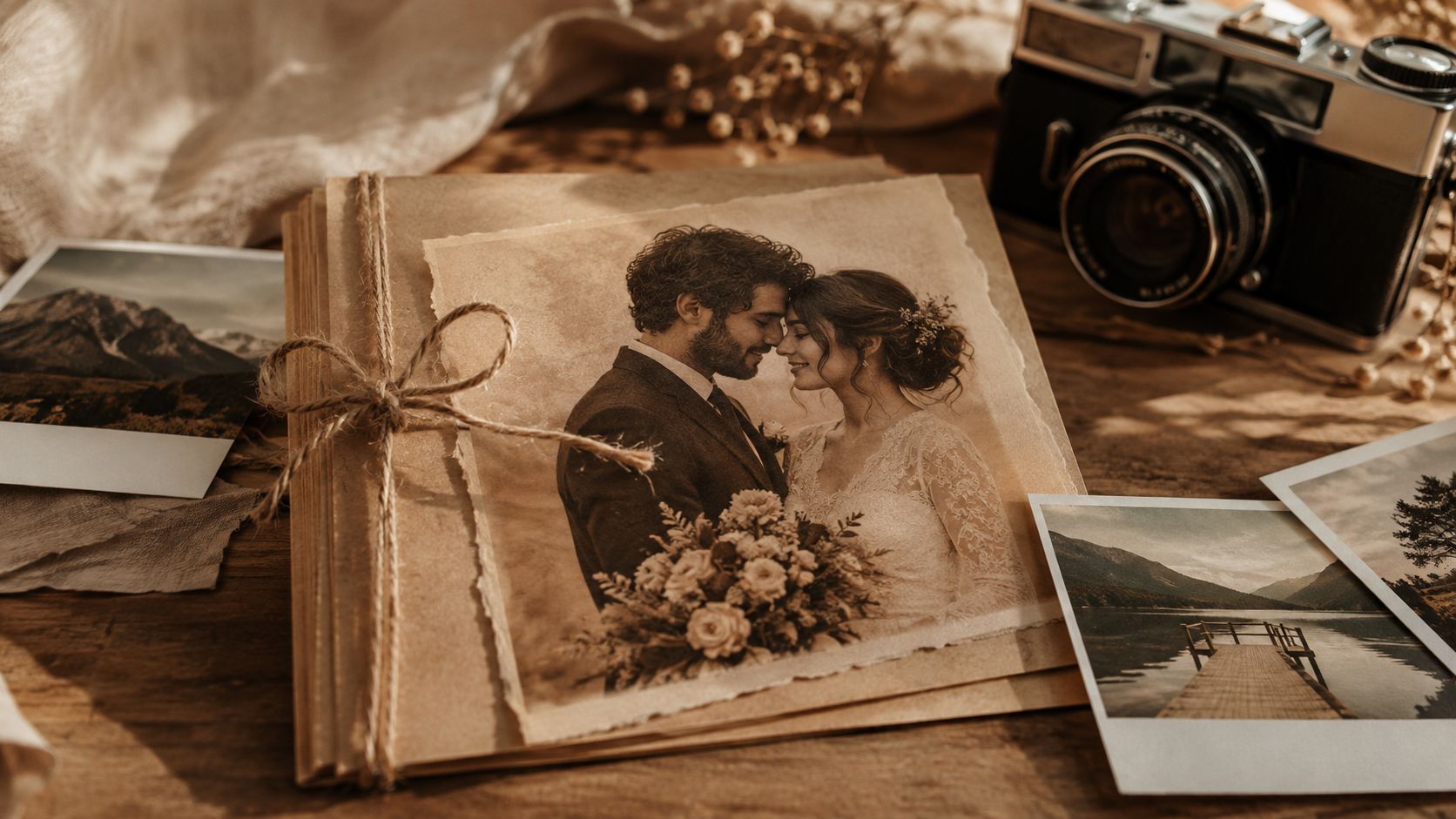
For a printed version choose high-resolution files and check a test print before production. Photo captions can be meaningful if they briefly explain the place or the moment, but do not turn the invitation into a photo album. The best result is achieved when the image creates an emotion and the text precisely says where the guest needs to arrive and how to confirm attendance.
8. Eco-friendly or minimalist green invitation
An eco-friendly invitation suits a couple for whom a connection with nature, conscious consumption and fewer decorations are important in the wedding concept. This direction can be realised with a printed invitation on recycled paper, seed paper or in a digital format. It is important that the chosen material and the text do not contradict each other.
Sample text
We invite You to our green celebration.
[Groom’s name] and [bride’s name]
will marry on [date] [time] at [venue].The celebration will take place surrounded by nature, so we recommend comfortable footwear.
If you wish to congratulate us, choose a gift that we can experience together, or contribute to [couple’s choice].Please tell us about your attendance by [date]
by phone [number] or by email [address].
In this example the practical information about footwear and gifts is given directly, but not categorically. This matters for outdoor weddings, where guests may need to know about the ground, the weather or accommodation. An eco-friendly message should not turn into moralising. It is enough to briefly explain which decisions you made and what you expect from guests.
Natural textures, leaf motifs, sand, brown and green colours suit the design visually. If you use decorations in the same concept, a green 30 cm eco balloon can become part of the colour accent, but it is better to keep the invitation design light and uncluttered.
An eco-friendly format also requires honesty. If you claim that the celebration is sustainable, describe specific choices, for example a digital RSVP form, the use of local suppliers or reusable decorations. One real detail is better than a long general promise about sustainability.
Comparison of 8 wedding invitation texts
| Style | 🔄 Implementation complexity | ⚡ Resource requirements | 📊 Expected results | ⭐ Ideal cases / advantages | 💡 Short tip |
|---|---|---|---|---|---|
| Classic formal wedding invitation | Medium: requires tidy formatting and printing | Quality paper, professional typography | A clear, official impression; widely accepted | Formal ceremony; traditional family feel | Use an elegant font and state the RSVP deadline |
| Modern minimal invitation | Low–medium: simple design, requires typographic taste | Few physical resources; good digital design | Modern, easy to read on screens; stands out | City / modern couples; minimalist aesthetic | Keep to white space and a limited colour palette |
| Personalised and humorous invitation | Low–medium: a lot of creativity in the text; managing sensitivity | Minimal – text and design; can be printed or sent electronically | Strong emotional impact; very memorable but risky | A close group of guests; couples with a strong sense of humour | Know your audience; limit risky jokes |
| Adventurous and themed invitation | High: requires theme creativity and coordination | Special print effects, themed illustrations, decorations | Creates anticipation; explains the celebration’s atmosphere | Themed / costume weddings; a careful vision for the decor | State the theme and dress code clearly; match the decorations |
| Digital or electronic invitation | Low: quick to create and distribute, technical decisions needed | Internet, design tools, interactive elements; little paper | Fast RSVP, easy updates; wide reach | International guests; tech-savvy couples; eco-friendly options | Shorten links, add an RSVP and an alternative contact |
| Traditional Lithuanian / sacred tradition invitation | Medium: requires authenticity and possibly consultation | Specific ornaments, quality printing, religious phrases | Emotional connection with family; well received by traditional guests | Church ceremonies; families who value culture | Confirm phrases with religious representatives; balance tradition with modernity |
| Photo and nostalgic invitation | Medium: requires quality photography and a design collage | High-resolution photos, professional printing or digital | Very personal and emotional; often becomes a keepsake | Couples with a rich history; vintage or sentimental style | Use ≥300 DPI photos; leave a clear text field |
| Eco-friendly or minimalist green invitation | Low–medium: simple design, requires searching for sustainable materials | Recycled paper, eco-friendly inks, possible extra costs | Shows values; appealing to environmentally conscious audiences; can be expensive | Eco-minded couples; nature ceremonies | Consider seed paper; inform guests about sustainable practices |
From a beautiful phrase to a clear invitation
A good wedding invitation text is not the one with the most poetic words. It is the one that the guest reads with pleasure and, after a few moments, knows exactly where to arrive, when to arrive and how to confirm attendance. Therefore choose a style not by which template looks best on screen, but by which one best suits your couple, your guests and the real course of the celebration.
The formal text suits an official ceremony, classic paper and a wider audience. The minimalist option will appeal to a couple who values brevity, clean typography and only essential information. The humorous text will work among close friends, but it must be used carefully with older or less close guests.
A themed invitation should match the whole celebration concept, not just the colours or the font. A traditional or sacred text suits a family for whom heritage and the meaning of the ceremony are important. A digital invitation is convenient when you need RSVP, a map, accommodation information or a quick update in one place. A nostalgic format tells the couple’s story through images, while an eco-friendly option should match the chosen materials and all the decisions of the celebration.
Before sending the invitation or handing it over for printing, go through this list of actions:
- Choose the tone: decide whether your celebration is formal, modern, personal, themed, traditional or deliberately simple.
- Enter the names and date: check the spelling of the names, the date and the day of the week.
- Check the venue and time: state the ceremony and evening celebration venues separately if they differ.
- Add RSVP information: include a specific contact, the reply deadline and, if needed, the guest’s choices.
- Give practical notes: include the dress code, accommodation, transport, gift wishes or information about the second day.
- Read it out loud: reading aloud quickly reveals unnatural phrases, overly long sentences and unclear humour.
- Match the design: the invitation’s colours, paper, font and decorative elements should go well with the table decor, balloons and other celebration accessories.
In Lithuania invitations have historically made up a small part of the overall wedding budget; one survey suggested allocating 0–2%, and ordered invitations cost between 30 and 400 litas, depending on the production method. This reminds us of something important: the invitation may be a small line in the budget, but it sets the first mood of the celebration and helps guests prepare.
If you have already chosen a direction for your wedding invitation text, visit Festive.lt and match your invitation idea with balloons, table decor and other celebration accessories. In one place you will find themed details that help keep a consistent wedding style from the first message to the venue.
 Table Decorations
 Party Accessories
 Christmas Costumes