





Party Ideas
Kids' Face Masks: How to Choose One That's Safe and Fun
If in the evenings there’s already a carnival costume lying on a chair in your child’s room, and a few different masks are scattered across the table, you’re definitely not alone. One looks pretty, another looks safer, a third is simply the one your child likes best — and then comes the usual parent question: what should you actually buy. With kids’ face masks the confusion in Lithuania is still considerable, because under the same name people often mean protection, a party, or beauty and play, all at once.
In Lithuania these masks show up in different contexts. In one place they’re needed for health and airway protection, in another they become a party accent, and in a third a child simply wants something fun that goes well with a costume. So the first question is never “which one is prettiest” — it’s what is it for.
Contents
- Three worlds under one name
- What types of kids’ face masks exist
- When a protective mask is genuinely needed
- How to choose the right size and material
- Themed masks and matching them with a costume
- A quick decision map for parents
Three worlds under one name
One day a mum buys a mask for nursery, the next she’s looking for one that suits a birthday party, and a week later she remembers flu season too. Same shelf, same name, but a completely different purpose. That’s why with kids’ face masks it’s worth first separating three distinct areas: protection, celebration, and everyday comfort.
When a mask is for protection
The first world is medical and protective masks. They’re needed when airway protection is the priority, especially during illness season, while travelling, or in healthcare facilities. For families this becomes a practical question, since respiratory illness monitoring in Lithuania shows the topic stays relevant, according to NVSC data.
Here it’s important not to chase the prettiest pattern. A protective mask acts like a shield, so the priority is purpose, fit, and whether it stops the child from breathing and moving normally. If a mask is only pretty but doesn’t protect, it’s doing a completely different job.
When a mask is part of a celebration
The second world is carnival, a birthday, or a photo shoot. Here a mask helps complete a look, creates a character, and becomes one of the costume’s details. In this context, what matters most is that it matches the outfit, doesn’t scratch the skin, and isn’t too heavy for a small face.
When a mask is play or skincare
The third world is play masks or cosmetic face masks. Sometimes they’re used for beauty play, sometimes as a gentle part of skincare, and sometimes just for fun dress-up. It’s easy to get confused here, because “cute” doesn’t mean “suitable”, and “fun” doesn’t mean “safe to wear for a long time”.
The most important rule is to answer one question before buying: what will the mask actually be worn for. Once that purpose is clear, the choice becomes much simpler.
| Category | Purpose | Age | Typical material |
|---|---|---|---|
| Medical mask | Protection from infections and particles | Depends on size | Three-layer material, often polypropylene |
| Carnival mask | Celebration, look, photo shoot | By theme and size | Fabric, plastic, decorative materials |
| Cosmetic mask | Skincare or beauty play | Per product instructions | Gel, cream, sheet material |
What types of kids’ face masks exist
When parents look for a single, clear answer, it helps to first separate three different goals. One mask is for protection, another for a party, and a third for play or skincare. It’s easy to mix these categories up, especially when the packaging shows a pretty colour or a favourite character.
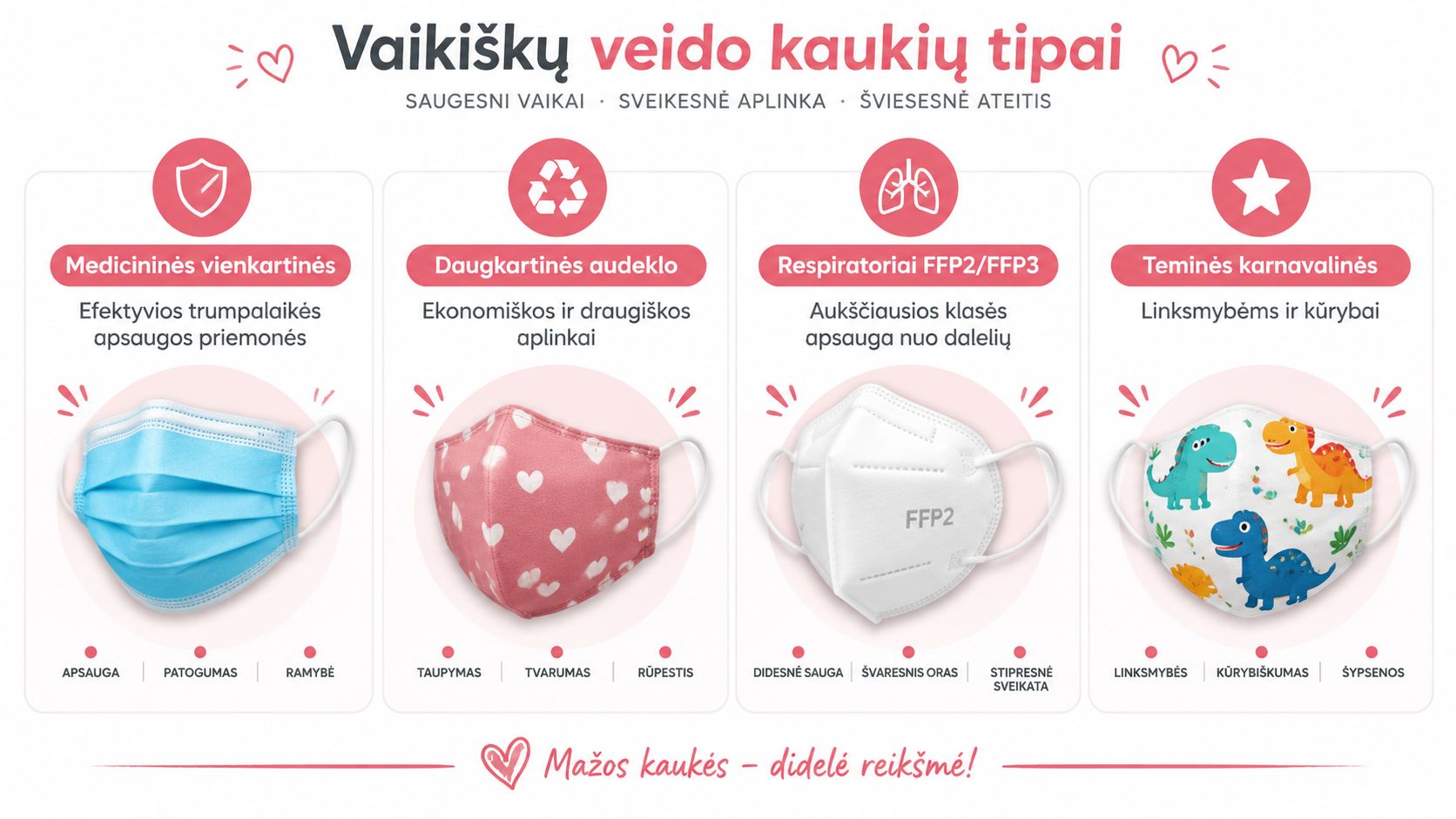
Disposable medical masks
Medical masks are made for short-term protection. Publicly listed descriptions often mention a three-layer polypropylene construction, where the middle layer filters and the outer layers help with protection and comfort, according to a Gintarinė vaistinė description. For parents, what matters isn’t just the colour but the layers, since they determine how the mask behaves in real-world wear.
FFP2 and FFP3 respirators
Respirators are a higher protection class solution. Under EN 149:2001+A1:2009 these are filtering half-masks, and Lithuanian sources indicate that FFP2 filters out about 95% of particles, while FFP3 filters out about 99%, according to a RESS explanation. Here what matters most isn’t just the filter, but the fit, because air leaking around the edges reduces the real effectiveness.
Reusable fabric masks
Reusable fabric masks are more often chosen for comfort or style. They can suit everyday wear or a party, if softness and easy wearing matter to the child. Even so, they shouldn’t be confused with genuine protective equipment.
Themed carnival masks
Themed masks are best suited to birthdays, carnivals and photo shoots. They can be part of a princess, unicorn, animal, superhero or other character look. Here what matters most isn’t filtration, but whether the mask matches the costume and whether the child is comfortable wearing it for the whole party.

If you need a carnival selection in one place, you can browse the kids’ face mask range, and before adding one to your basket, it’s still worth thinking about which occasion it will actually be used for.
| Theme | Mask type | Matching accessories |
|---|---|---|
| Princess | Shiny or lace mask | Crown, dress, sparkly headband |
| Superhero | Mask with contrasting colours | Cape, gloves, emblem |
| Animal | Soft themed mask | Ears, tail, face-friendly makeup |
| Unicorn | Light, fantasy-style mask | Horn, sparkly accessories, pastel clothing |
When a protective mask is genuinely needed
A morning doctor’s visit, an afternoon bus ride, and an evening spent in an enclosed, busy place — in situations like these, a protective mask becomes a practical solution for a child, because what matters most here isn’t looks but real protection.
In Lithuania, respiratory protection for children isn’t just a theoretical topic. In 2023, almost half of children’s health indicators were related to the respiratory system, and 48.4 out of every 1,000 children were hospitalised due to respiratory illnesses, according to a Institute of Hygiene publication. That doesn’t mean every child needs one every day, but it helps parents understand why the topic stays relevant.
Where protection makes sense
A protective mask is usually worth using when a child is going to a healthcare facility, travelling on public transport, visiting enclosed and busy places, or in an environment with higher illness rates. Lithuania’s public health monitoring shows that around 350,000–480,000 cases of acute upper respiratory illness are registered each year, of which about 100,000 are in the children’s group, according to NVSC data. Numbers like these explain why parents are looking for real protection, not decoration.
Why fit matters more than a fancy name
A respirator works when it sits close to the face. If air gets in around the edges, the filter class matters less, since part of the air bypasses the material itself. That’s why it’s sometimes better for a child to have a simpler mask that fits well than a theoretically stronger one that sits badly on the face.
Practical rule: if a mask presses too hard, slips off the nose, or makes the child keep touching it, it’s no longer good protection.
A simple question helps parents too: does the child need a respirator today, or is a briefly worn medical mask enough. In a busy, enclosed space where extra protection is wanted, a respirator is the more logical choice. In a calmer environment, where the mask is only needed briefly, protection that’s too big and uncomfortable often just becomes an obstacle.
How to choose the right size and material
The right size for a child is almost as important as the purpose itself. A mask should cover the nose and chin, but shouldn’t press, climb into the eyes, or leave obvious gaps at the sides. If it “looks kid-sized”, that still doesn’t mean it will actually fit.
Checklist before buying
Before adding a mask to your basket, it’s worth quickly checking a few things:
- Measure the face: the main thing is that the mask isn’t too wide or too tall, otherwise it slips and becomes uncomfortable.
- Check the nose area: if there’s a gap there, the child will keep adjusting the mask by hand, and it will become more annoying than useful.
- Assess the material: softer, gentler materials tend to suit sensitive skin better and irritate it less.
- Look at the layers: a three-layer construction matters when we’re talking about medical purpose and filtration.
Kids’ masks are often labelled by age, but the age label isn’t the final answer. A mask can fit one six-year-old perfectly and be too big for another child the same age, especially if their face is smaller. So it’s best to check the size not by eye, but by trying it on the specific child’s face.
Material and comfort
Lithuanian retail shows that some medical masks rely on layered polypropylene. For parents, this means something simple: a pretty mask needs to be not only pretty but also easy to breathe through. If a child wears it for only a few minutes and wants to take it off, the problem is usually not stubbornness, but the wrong size or material.
Disposable medical masks should be changed once they get damp, and it’s also important not to keep them on all day. It’s a good reminder for parents planning to use a mask for a longer stretch, since a child’s comfort and hygiene go hand in hand.
If you’re looking for a mask for craft projects or decorating, you can also look at the kids’ white mask made for painting, but even here it’s worth separating play from actual wear. One solution suits painting, another suits everyday wearing.
Themed masks and matching them with a costume
At kids’ parties, the mask is often the small accent that ties the whole look together. The costume can be lovely, the wig fun, the hat bright, but it’s usually the mask that defines the character’s face. When it’s chosen precisely, the outfit looks cohesive, even if the other accessories are quite different.
When a mask becomes the centre of the look
A princess theme suits soft, elegant masks with sparkle or lace. A fairy look works nicely with light pastel colours, while a superhero costume looks better with clear shapes and stronger contrasts. Animal costumes often need nothing more than a simpler mask that highlights the ears, a warm colour range, or a fun facial accent.
When planning a birthday, it’s worth thinking about the whole combination, not just one item. A unicorn mask pairs nicely with a sparkly headband, and a pirate mask looks much better with a little hat and simpler accessories. Looking at the whole picture like this helps avoid the chaos where everything is pretty on its own but doesn’t work together.
When to choose face paint instead of a mask
Sometimes a mask isn’t the most comfortable solution for longer wear. If a child is very active, dances, runs around, or wants to eat and drink the whole time, face-friendly makeup can be more comfortable than a fully covering piece. This especially helps when the theme allows you to stick to colours or drawings rather than covering the whole face.
Practical observation: the longer a mask stays on the face, the more important it is that it isn’t rough and doesn’t rub the ears or nose.
To avoid skin irritation, it’s worth checking whether the mask’s edges are soft, whether there are no overly stiff seams, and whether the straps don’t press. Things like this often seem like minor details — until the first birthday party, when a child no longer wants to wear it after half an hour. That’s when it becomes clear that comfort isn’t an extra, it’s the essence.
For themed parties it pays to choose not just by colour, but by how the mask “talks” to the rest of the costume. Sometimes one bold motif is enough, for example a kids’ ladybird mask, to make the whole look clear and easily recognisable for a child. If the costume already has plenty of detail, the mask can be calmer and simply round off the overall look.
In some Lithuanian themed-goods categories you’ll also find more playful, carnival-oriented offers, some of which highlight children’s sensitive skin and more natural compositions, according to an Emama offers page. For buyers, that’s a reminder of a simple rule: read the description, not just the photo. The prettiest mask isn’t right if it’s meant for a different use case.
A quick decision map for parents
When you need to decide quickly, it’s best to split everything into three scenarios. Then you’re no longer torn between design, protection and comfort, because each situation has its own logic. This especially helps when the party is close and the decision needs to be made in a few minutes.
For a party
Choose a themed mask if the main priority is the look, a birthday, or a photo shoot. Check whether it matches the costume, doesn’t scratch the skin, and lets the child move comfortably. If the party theme is clear, the mask should reinforce it, not interrupt it.
For everyday protection
Choose a medical mask or a respirator if the goal is protection from infections or a busy enclosed space. What matters most here is size, fit and real comfort, not decoration. If a mask doesn’t suit the child, it’s better not to use it than to wear it just for the sake of formality.
For play or a photo shoot
Choose an option that lets the child move freely and doesn’t cause irritation. Carnival and themed masks work best here, since they create a character without becoming a medical obligation. If you need to put together the whole party quickly, Festive.lt offers a selection of carnival masks, wigs, hats and accessories in one place, and the goods are stocked in Lithuania, which makes planning simpler.
A kids’ face mask isn’t a complicated purchase once you know what to look for. Once you separate protection, celebration and play, every choice becomes a lot calmer.
If you want to quickly put together a mask, costume and other party accents in one place, head to Festive.lt. There you’ll find carnival masks, wigs and accessories that help solve both birthday and themed-party questions without extra hassle. That’s handy when what you want isn’t another opinion, but a concrete solution.
Table Decorations