






Party Ideas
Buying Costumes Online: How to Choose the Right One


Saturday morning is almost here and there’s still no costume. The child is waiting for Halloween, nursery is asking for themed outfits, or the party has come together so quickly that there’s no time left to drive round several shops wondering whether the size will fit or whether the set will actually include every piece. When buying costumes online, what matters most isn’t a prettier photo, it’s whether the order will arrive on time, whether the costume will match your body measurements, and whether a return won’t turn into an unnecessary dispute over packaging or missing parts.
In Lithuania, shoppers are increasingly choosing the convenience of ordering from home, and parcels often travel to parcel lockers, which have become a standard way to collect orders. That’s exactly why online shopping is appealing when you need something fast, but it also carries a clear risk: the costume could turn out too small, too big, or simply different from the photo, so before you pay, it’s the decision you need to check, not just the model.
Table of contents
- When buying a costume online is the best solution
- How to choose the right size and age group
- What to check when assessing fabric and contents
- Searching and filtering by theme and occasion
- Evaluating delivery terms and return policy
- Final checklist before ordering
When buying a costume online is the best solution
Buying a costume online is worthwhile when time is tight and a physical shop’s selection would be too limited. If you need a specific character, an unusual size, or outfits for a whole group, an online shop usually offers far more options than a seasonal local shelf. The same applies when only a few days are left before the event, since driving around town often eats up more time than the order itself.
When shopping online gives you the advantage
If you notice there’s little time left before the event, focus first on availability and delivery time rather than design. Online shopping works best once you already know what you want, say, a costume of a specific theme for your child, rather than something vaguely “carnival-ish.” That approach cuts down on aimless browsing and helps you shortlist genuinely suitable options faster.
Rule of thumb: when the event is right around the corner, don’t pick the “prettiest” costume, pick the one whose size, contents and delivery are clearly stated on the product page.
Another advantage is that online shopping makes it easy to compare several shops at once, checking price, stock and return conditions side by side. This matters especially for families, schools or clubs that need to coordinate several costumes at once. In these situations, a single wrong choice is enough to throw the whole theme off.
For more on when it’s better to buy versus rent, see this helpful guide on buying versus renting.
How to choose the right size and age group
The biggest mistake is buying by age rather than by actual body measurements. “6 years” or “L” sounds convenient, but manufacturers cut their patterns differently, some narrower, some looser. So at home, start by measuring height and chest circumference, and for children also the waist and head circumference if the costume includes a hat, hood or other headpiece.
How to measure at home
Measuring should be simple and precise. Have the child or adult stand up straight, measure without bulky clothing, and compare the centimetres against the manufacturer’s size chart rather than a generic age label. If the chart states the costume suits a height of 110–120 cm and the child is 115 cm, it’s worth choosing the upper size, so the outfit doesn’t restrict movement and stays comfortable throughout the event.
| Height (cm) | Chest circumference (cm) | Recommended costume size |
|---|---|---|
| 100–110 | per manufacturer’s chart | Smallest matching size |
| 110–120 | per manufacturer’s chart | Medium matching size |
| 120–130 | per manufacturer’s chart | Larger matching size |
What to look for on the product page
Check whether the item has a separate size chart based on height, not just age. That’s the clearest sign the seller expects a precise fit rather than guesswork. If the chart is only very general, buy more cautiously and choose a size from the wider end of the range, so the costume doesn’t feel too tight on the very first evening.
You’ll find more practical tips in this guide to choosing children’s carnival costumes.
What to check when assessing fabric and contents
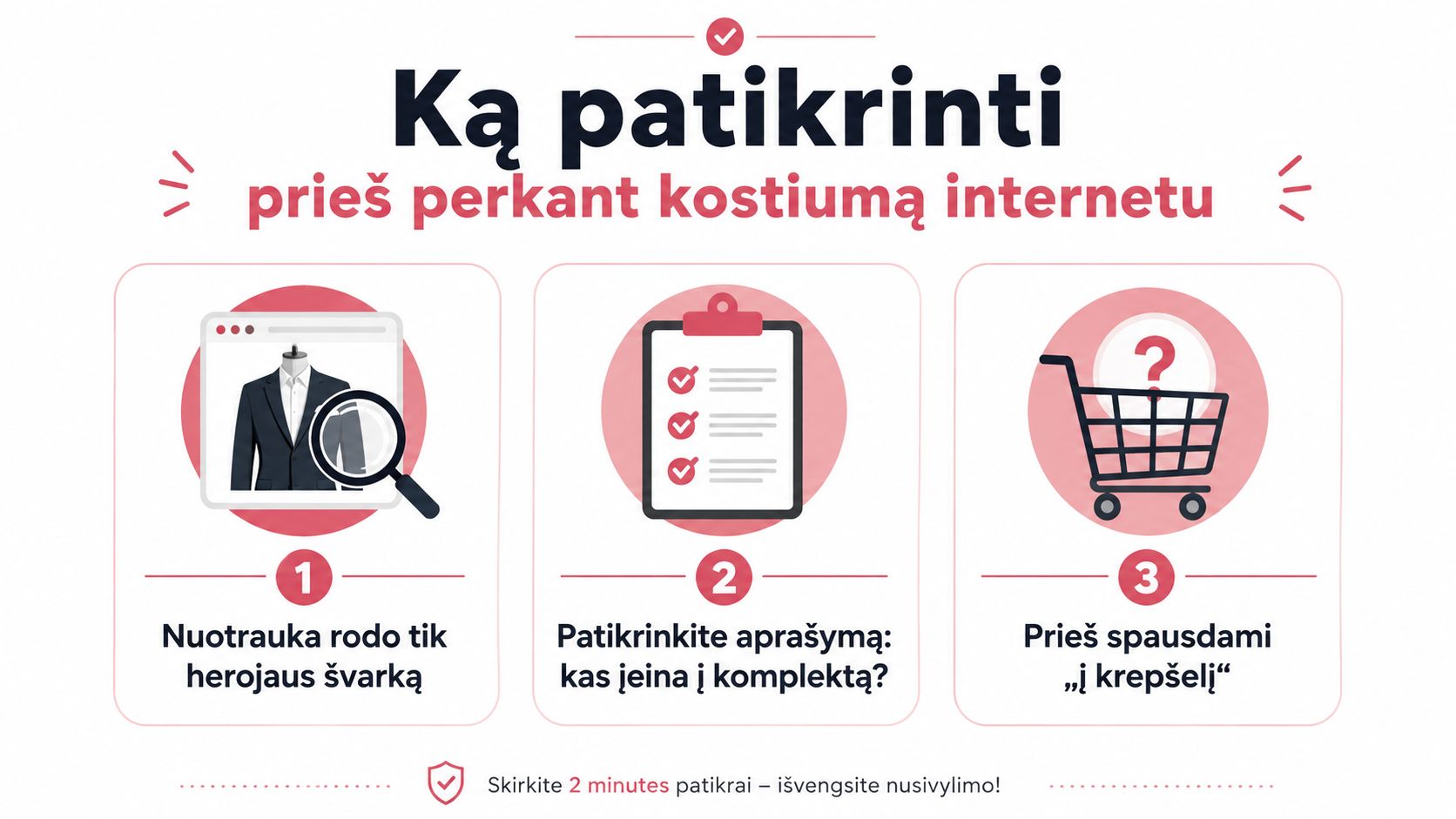
A photo often misleads not directly, but by omission. In the picture you see the full look, but the product description may cover only one piece of the outfit, while everything else, the hat, belt, mask, gloves or cape, is sold separately. So before adding an item to your basket, read the contents line first, not the headline.
Fabric and stitching
Polyester usually works fine for a short party or a photoshoot, but for longer wear in a warm room it can be less comfortable. If there’s a cotton blend, it tends to be gentler on the skin, so for children or for longer wear that option is often the safer choice.
Seams and edges matter too. If the description mentions reinforced seams or neatly finished edges, that’s a good sign the costume will hold up beyond the first time it’s worn. Cheaper models often look fine only on screen and quickly lose their shape in real life, especially if a child is moving around or dancing energetically.
What most often differs from the photo
Buyers are usually disappointed not by the colour, but by a missing piece of the set. The look shown in the photo is often more complete than the actual product, so read carefully how many pieces are included, whether accessories are included, and whether you’ll need to buy anything extra. Also check the washing instructions, since if the costume can only be dry-cleaned, reusing it becomes far less convenient.
If the description doesn’t give a clear list of included parts, treat that as a warning sign, not just an oversight.
What’s worth comparing before you buy
- Number of pieces. Check whether it’s a full costume or just the top part.
- Fabric composition. Consider whether the costume suits short-term wear or a longer occasion.
- Accessories. Check whether the mask, hat or belt is included in the price.
- Washing method. Find out whether you’ll be able to care for the costume at home.
- Seam description. This often reveals more than the photo.
Searching and filtering by theme and occasion
Start your search not with the word “costume,” but with the occasion. Halloween, Mardi Gras, a children’s birthday, a themed party or a school event already narrows your choice down to genuinely relevant categories. Filters then stop being an extra step and become the fastest way to weed out unsuitable options.
How to search with purpose
If the shop has clear categories, go straight into them rather than browsing the general catalogue. For example, the carnival costumes category lets you see themed options right away and narrow the search by age or occasion much faster. That’s far more efficient than scrolling through the whole range from start to finish.
Keywords should be specific. Instead of a generic phrase, type your exact need, for example, “pirate costume for a 110 cm child” or “Halloween costume for adults.” A search like this helps the system filter out anything that doesn’t match the size, theme or audience.
Which filters to use first
Start with age group, size, colour and theme. If there are additional filters available, use them only once the main ones have already narrowed your choice. The less time you spend on irrelevant results, the less risk you run of hastily picking a costume that looks great but isn’t practical.
It’s best to open several product pages at once and compare photos, prices and availability. This kind of comparison helps you see which listing has the clearer description and whose delivery better fits your dates.
Evaluating delivery terms and return policy
Before ordering, look not only at the price but also at the delivery logic. If you need the costume tomorrow or the day after, a parcel locker, a courier and express delivery aren’t the same thing, even if each option looks convenient. What matters is which method will genuinely meet your date, not just which one sounds nice at checkout.
How to compare delivery options
A parcel locker usually works best when you want to collect your order at a time that suits you and don’t want to arrange a meeting with a courier. Home courier delivery is better when the order is larger or you’d rather not travel to a terminal. Express delivery becomes important when the event is already tomorrow and time matters more than convenience details.
The rule is simple: if the date is critical, choose a seller who clearly states how quickly items are dispatched from their Lithuanian warehouse, not one who just makes a general promise.
It’s also worth checking whether the shop clearly states the delivery price and terms. If your basket is just short of the free-delivery threshold, it can sometimes make sense to add a small extra item, but only when you genuinely need it. Buying something just “to hit the threshold” shouldn’t become a habit.
What to look for in the return policy
Returns are a critical point, because a costume can still turn out not to fit even when you measured everything correctly. Read how long you have to return an item, what condition the packaging needs to be in, whether tags must remain attached, and who covers the shipping costs. If these terms are vague, the odds of an unpleasant surprise are high.
Festive.lt, operating in Lithuania, sets out its return and refund process in its policies, so read them alongside the specific product before buying. The same applies to other online shops, since general terms often differ from what a buyer expects based on a photo or an advert.
| Criterion | Parcel locker | Courier | Express delivery |
|---|---|---|---|
| Convenience | Collect at a time that suits you | Parcel arrives at your address | The fastest option for an urgent occasion |
| Best when | You want flexibility | The order is larger or travel is inconvenient | The event is very close |
| Risk | You need to travel to collect it yourself | You need to be at the given address | Usually the most expensive, and timing needs precise checking |
Final checklist before ordering
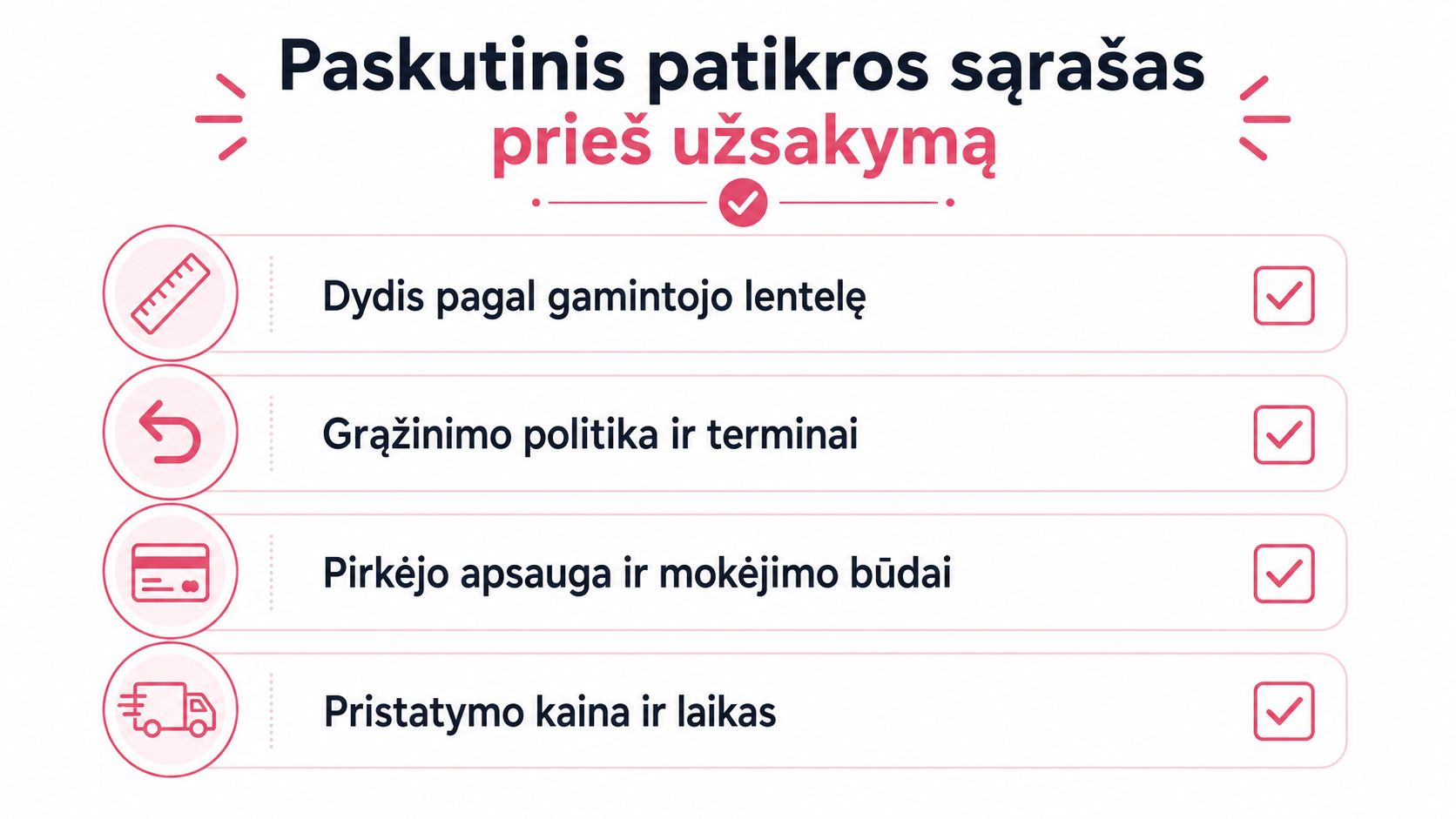
If the event is already tomorrow, a nice photo alone isn’t enough. Before paying, check the size, the contents, how realistic the delivery is, and the return conditions. This will help you avoid a situation where the parcel is late or the costume arrives missing a visible piece.
What to check one last time
- Size against the manufacturer’s chart. Double-check height, chest circumference and any other stated measurements.
- Contents. Make sure the price includes every piece shown in the photo.
- Fabric and care. Check the composition and the washing or cleaning requirements.
- Delivery time. If the stated timeframe seems overly optimistic and stock is unclear, contact the shop before buying.
- Return conditions. Read the deadline and the packaging and product condition requirements.
Festive.lt, operating in Lithuania, sets out its return and refund process in its policies. Read them alongside the description of the specific costume. If even one point is unclear, hold off on payment and clarify it first.





 Table Decorations
 Party Accessories
 Christmas Costumes