







Party Ideas
7 Birthday Card Ideas for Kids

The birthday is coming up fast, the guest list is nearly finished, but one detail is still missing. You need a nice birthday card for kids, but it also has to work for that specific child, their age, and the party theme. One child will love a bold dinosaur, another a mermaid, and another a short note with their name and favorite color.
When choosing, it helps to consider how much time you have, whether the card will be sent digitally, printed at home, made together with the child, or ordered from a maker. Print quality, delivery time, text size, and how well the design matches the balloons, decorations, and costumes all matter too. Below are seven different directions that differ not just in look, but in the actual way they’re made.
Contents
- 1. Canva templates for kids’ birthday cards
- 2. Adobe Express digital card
- 3. Minted personalized premium card
- 4. DIY card-making kit
- 5. Free printable template
- 6. Etsy custom card from a maker
- 7. Pinterest idea and DIY tutorial
- Comparison of 7 kids’ birthday card sources
- Choose a template that fits your party timeline
1. Canva templates for kids’ birthday cards
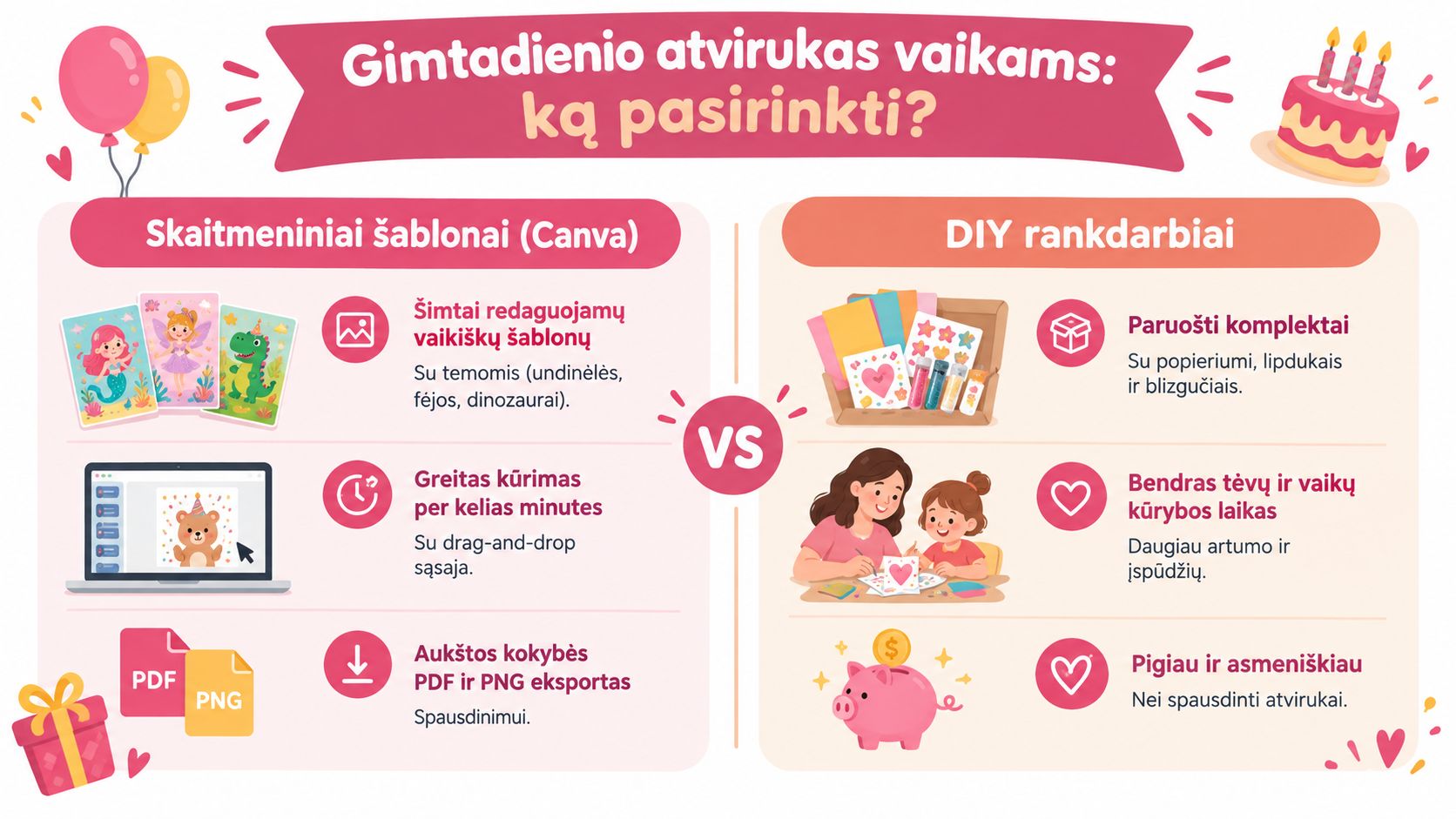
Canva is great when you want to quickly create a card with the child’s name, age, and chosen theme. The platform offers editable designs where you can change text, colors, and illustrations, and add a photo. For a kids’ party, it’s easy to find dinosaurs, cars, fairies, mermaids, or other bright motifs.
This approach is especially handy for parents, kindergartens, and teachers. For example, a kindergarten teacher can prepare one design and simply swap in a different name for each child. Parents can create a digital greeting or print the file at home.
How to make the card look polished
Start with the party theme, not the first template you like. If the child will wear a dinosaur costume, choose a matching color palette and illustrations. If the party will have mermaid decorations, use ocean, shell, or underwater details on the card.
- Add the name and age: this instantly makes the card feel more personal.
- Pick a clear font: larger letters are easier for younger kids to read.
- Limit the decoration: too many stickers, characters, or colors can bury the main message.
- Check the file before sharing: review the name, date, photo cropping, and text alignment.
Rule of thumb: a card for a child needs to be not just pretty but easy for the eye to “read.” One bold character and a clear message often works better than an overloaded design.
If you’re printing at home, test one sheet first. Colors can look different on screen than on paper, and important details sometimes end up too close to the edge. For a digital send, check that the text stays readable on a phone.
2. Adobe Express digital card
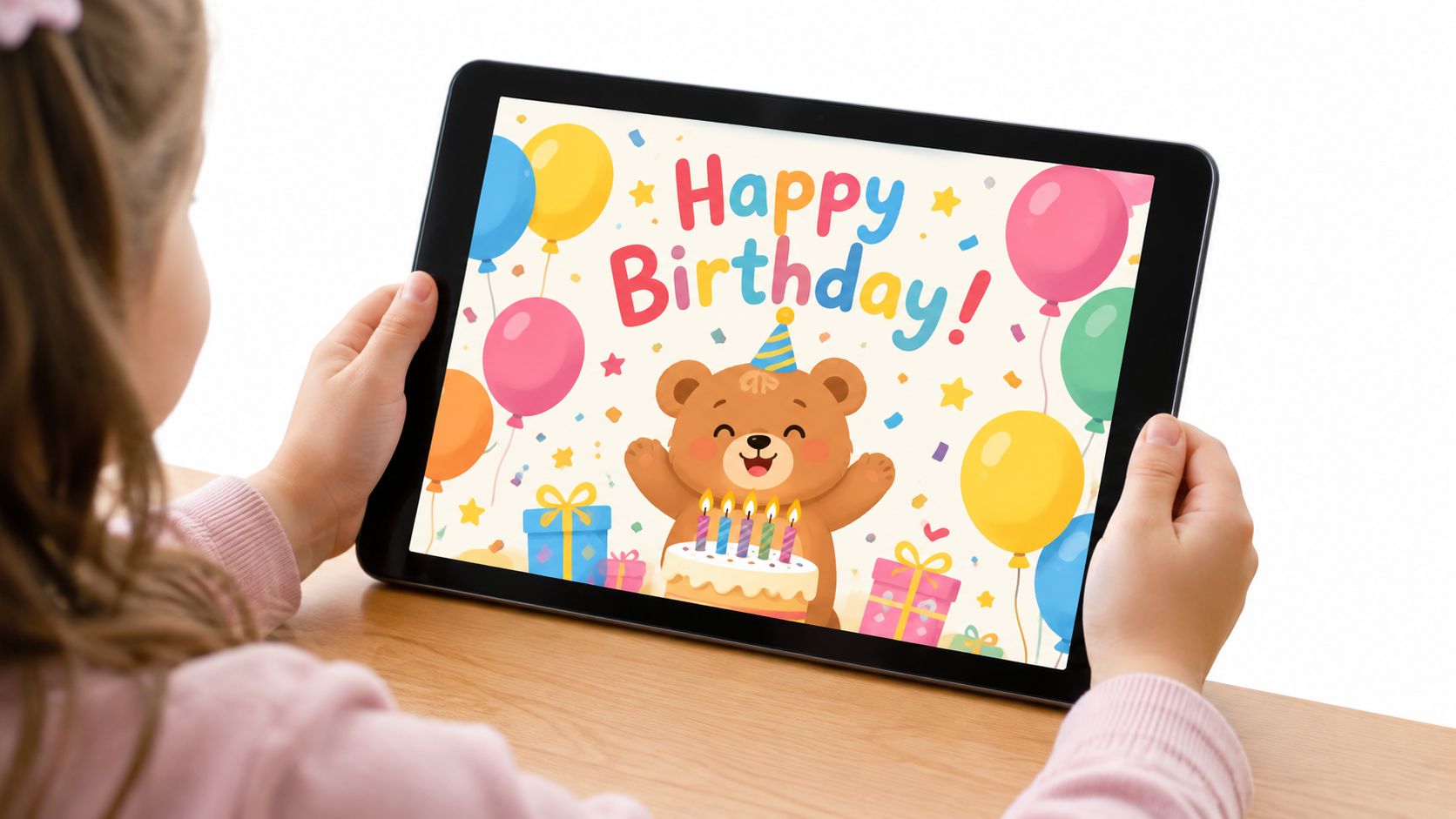
When grandparents live in another city and classmates are greeted in a shared group, Adobe Express lets you quickly put together a digital card. You can choose a static or animated format, upload a photo, add a personal message, and send it by email or social channels. This option is great when speed, a small budget, and reaching someone on their phone matter most.
Animation adds more motion than a paper card. Balloons can rise, birthday candles can flicker, and photos can change. But for children, especially younger ones, too many moving details can make the text harder to follow. A simpler design often suits a short message better.
Start with the party theme. For a dinosaur party, pick colors similar to the decorations and costume; for a mermaid theme, use ocean tones and underwater details. Once the card is ready on your phone, check the following:
- Short text: one clear idea reads better in an animated file.
- Photo: choose a bright, well-lit image and check the cropping.
- Sound: the music shouldn’t drown out the greeting, especially if the recipient will use a phone.
- Share link: test it on another device and make sure no extra account is required.
The card can be matched with a kids’ birthday invitation. A birthday invitation for kids helps keep the same colors and illustration style. If the greeting is being sent at the last minute, choose a file the recipient can open with a single tap. A digital card is fast, but it doesn’t create a physical keepsake and depends on the internet connection, sound settings, and the recipient’s device.
3. Minted personalized premium card
When you want to keep the greeting as a beautiful keepsake, an ordered card is worth considering. Minted offers designs created by independent artists, so they can feel less generic than a quickly assembled digital option. You can personalize the name, age, photo, colors, and font.
This choice suits a party whose theme is planned well in advance. The card’s colors and illustrations can be echoed in place cards, decorations, balloons, and the child’s costume. For a fairy party, choose a lighter palette and delicate illustrations. For a dinosaur theme, contrasting colors and a bolder character work better.
Start the ordering process with the final text and photo. Before paying, review the layout, check the delivery terms, and make sure the chosen image is sharp enough. Read the name several times, since mistakes are harder to fix on a personalized item.
The purpose of the card matters too. Thicker paper looks lovely when handing over a gift but can be impractical if the greeting will be shared with a large group of kids. Pick one main theme instead of trying to combine all the child’s interests. That way the card ties in more easily with the decor and costume.
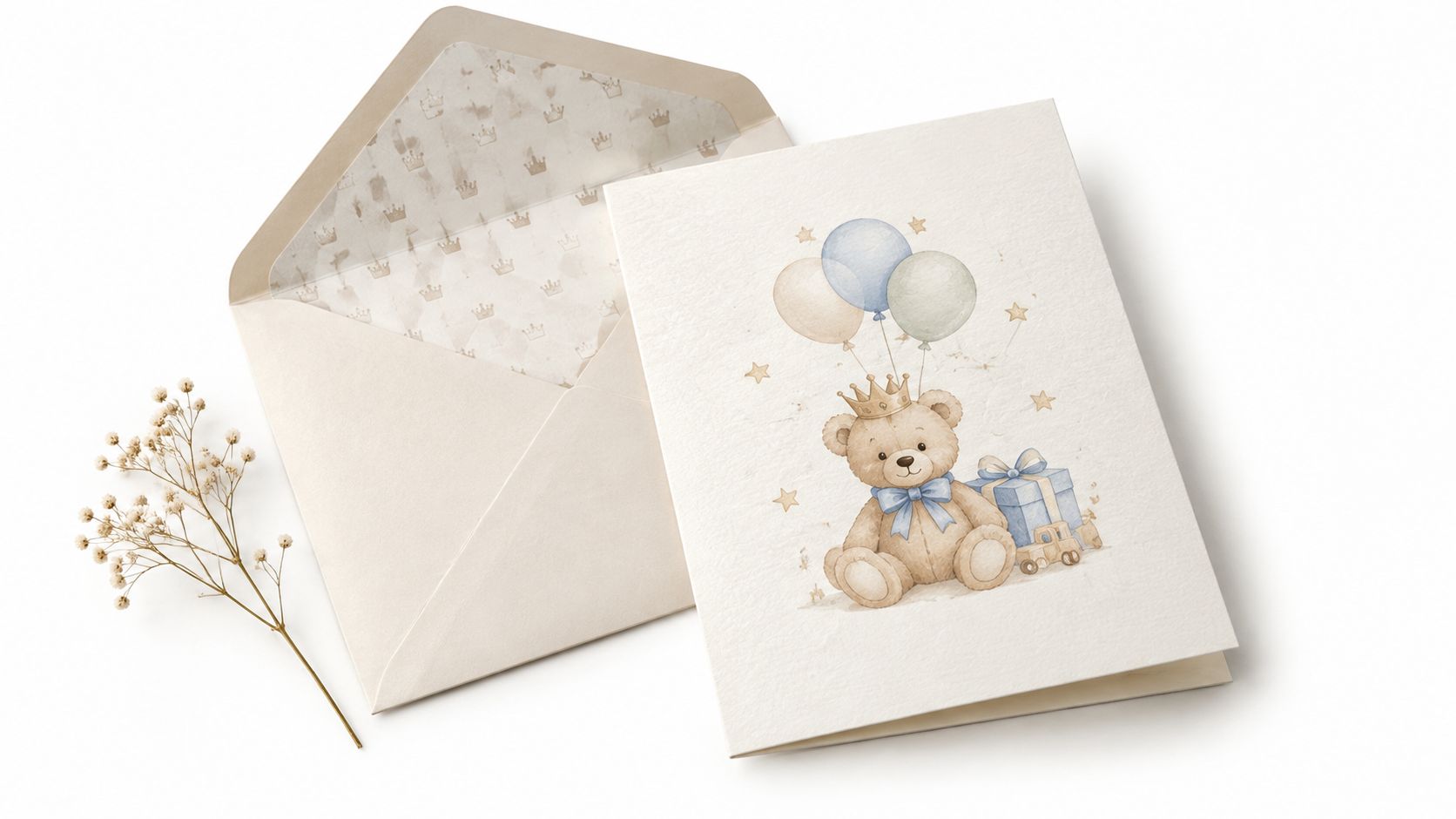
Ordering requires more planning and costs more than a digital file, and it’s hard to change once the party theme or the child’s age shifts. It’s the right choice when finish, photo quality, and lasting value matter more than speed.
4. DIY card-making kit
A craft kit is worth choosing when the making itself becomes part of the celebration. Paper, stickers, markers, ribbons, decorative bits, and instructions let parents and a child, grandparents and a grandchild, or a kindergarten group create a card together.
Start with one main detail. For a mermaid theme, blue paper, shell stickers, and a few silver accents are enough. For a dinosaur card, choose a green background, footprints, and one large character. The same color scheme can be repeated on the table, in balloons, or in the child’s costume, so the card naturally blends into the party decor.
The child doesn’t need to copy the example exactly. Let them choose the colors, stick on the character, draw a cake, or write a few words. This kind of card is especially fitting for a close family member, since its value comes from the child’s own effort.
Before you start, lay out the supplies in one place, prepare the greeting text, and set aside an envelope. Small decorations peel off easily, so attach them carefully. If a group will be making the card, prepare a simpler backup version in advance.
Crafting takes more time and adult supervision, especially with scissors, glue, or small parts. For a large batch of identical cards this method is inconvenient, but for a single child it offers more personal touch than a ready-made template.
5. Free printable template
Free printable templates suit a budget-friendly, fast solution. On Greetings Island and similar platforms you can find foldable cards, simple illustrations, and themed kids’ designs that you can print on a home printer. This option is convenient for parents, schools, and kindergartens when several similar cards are needed.
Its advantage is low preparation cost and the ability to start right away. However, a free template may include a promotional element, less precise print quality, or limited text-editing options. It’s therefore worth treating the first copy as a test rather than printing the whole batch immediately.
Simple preparation process
Download the template, add the greeting, and check how it looks printed. If the file is a PDF, text editing may be limited. In that case you can write the message by hand, use the card as a base, or add the text in another program before printing.
Before printing: check the fold line. A nice design won’t help if the text ends up on the back after folding or the illustration is off-center.
For more ideas, you can browse birthday greetings for kids and pick a short text suited to the child’s age. Simple wishes work for a younger child, while an older child can enjoy a playful hint about the gift, costume, or party activity.
A hand-added name, a few marker accents, or a sticker often makes a template feel more personal. It’s a good compromise between printing speed and a handmade feel.
6. Etsy custom card from a maker
Etsy is a good fit when you’re not after a mass-produced template but a specific maker’s style. Sellers can produce a card with the child’s name, age, photo, or a special message. Some items are entirely handmade, so each card may have small differences in texture, color, or finish.
This option is especially good for a special child, a family occasion, or a themed party where you want a standout detail. You can look for mermaid, fairy, dinosaur, space, or car motifs, but it’s important to describe exactly what you need to the seller.
How to work with an independent maker
Before ordering, review the seller’s portfolio and reviews. If the photos show pastel designs but you want a bright, playful card, message them first and ask whether that kind of change is possible.
- Give all the details in one message: name, age, theme, and the wording you want.
- Ask about proof approval: it’s important to know whether you can check the personalization before production.
- Check the shipping country: an international order can be tricky if the birthday is already close.
- Keep communication on the platform: that way there’s a clear record of the design and deadline agreement.
An Etsy card can be paired with other party details, but you don’t need to copy every element blindly. It’s enough for the card’s character to match the child’s costume, and for one or two colors to repeat in the decorations. If you’re looking for a shared theme to tie everything together, party supplies can help match the rest of the party elements.
The main downside is the waiting and communication risk. The final result depends on the maker’s production schedule, shipping, and how precisely you convey your wishes.
7. Pinterest idea and DIY tutorial
Pinterest works best as a source of inspiration when you don’t yet know what kind of card you want to make. In the search you can combine a theme and a format, for example looking for a dinosaur, mermaid, or car birthday card for kids. Many ideas come with materials lists, step-by-step instructions, and links to video tutorials.
This approach is handy for parents, teachers, and event organizers who want to adapt one idea for a larger group. That said, the result shown in a photo can look simpler than reality, especially if you use different supplies or lack hands-on skills.
How to pick an achievable idea
Don’t save dozens of pretty but unrealistic examples. Narrow it down to a few ideas and assess whether you have all the materials, and how much cutting, gluing, and drying will be needed.
- Search with theme keywords: add “mermaid,” “dinosaur,” or another chosen motif to your general search phrase.
- Read the description: the photo doesn’t always show all the prep work required.
- Check the tutorial: a video can reveal the trickiest step.
- Choose the simpler option: a neatly finished simple card beats an unfinished ambitious project.
Tie the theme to the party through one clear accent. If the child will wear a superhero costume, the card could feature a shield or a cape rather than a full comic-book page. If the party has a woodland-animal theme, choose a leaf, paw print, or animal-ear motif.
Pinterest doesn’t limit creativity, but it won’t finish the product for you. It’s the best choice when you have time to experiment and want the card-making itself to become part of the celebration.
Comparison of 7 kids’ birthday card sources
| Product | ✨ Key features | ★ Quality / UX | 💰 Price / value | 👥 Target audience |
|---|---|---|---|---|
| Canva Premium templates | Hundreds of kids’ themes, drag-and-drop, large media library, sync | ★★★★☆ – intuitive, professional | 💰 €13/mo (1-month trial) or limited free | 👥 Parents, kindergartens, event organizers |
| Adobe Express (free) | Animated e-cards, sound, social integration, QR codes | ★★★★☆ – fast, appealing | 💰 Free (ads in some places) | 👥 Parents, grandparents, social media users |
| Minted (premium print) | Personalized designs by independent designers, thick cardstock, envelopes | ★★★★★ – top print quality | 💰 €3–€10+/piece (bulk orders) | 👥 Premium buyers, event planners |
| DIY craft kits | All supplies + instructions, themed sets, kids/varying skill levels | ★★★☆☆ – very personal, depends on execution | 💰 €10–€20 per kit | 👥 Parents, kids, schools, crafty family members |
| Free printable templates (Greetings Island) | PDF A4/A5, quick download, no registration needed | ★★☆☆☆ – depends on the printer | 💰 Free (printing costs) | 👥 Budget-minded parents, teachers |
| Etsy – handmade & personalized | Unique, personalized, many independent sellers, eco materials | ★★★★★ – high artistic quality | 💰 €5–€25+ / piece + shipping | 👥 Buyers who value uniqueness, gift shoppers |
| Pinterest – inspiration | Millions of DIY ideas, tutorials, materials lists, collections | ★★★☆☆ – quality varies, plenty of ideas | 💰 Free | 👥 Crafty parents, event planners, teachers |
Choose a template that fits your party timeline
The best birthday card for kids isn’t the one with the most decoration. It’s the one that fits your situation. If time is short, choose Canva or Adobe Express. These tools let you quickly change the name, age, photo, and theme, and you can send the final result digitally or prepare it for print.
If budget matters most, choose a free printable template. You can enhance it with a hand-written name, stickers, or the child’s own drawing. If you want a shared activity, craft kits or Pinterest tutorials are a better fit. They take more preparation, but the child gets to take part in making it and ends up with something not just pretty, but personally meaningful.
Minted and Etsy are better suited when uniqueness, finish, and the ability to order a specific design matter most. An ordered card isn’t practical if the birthday is tomorrow. But for a party planned well in advance, it can become a lovely part of a gift or a matching party accent.
Before sharing or ordering, run a quick check:
- Text: is the child’s name, age, and greeting spelled correctly?
- File: does the digital card open on a phone and keep its sound and animation settings?
- Print: have you checked a test sheet, the colors, and the fold lines?
- Delivery: is there enough time to produce and deliver the chosen product?
- Theme: do the card’s colors and characters match the decorations, balloons, and costume?
In Lithuania, the greeting-card tradition runs deep. The first postcards were printed in 1875, colored ones appeared in 1890, and after the ban on the Lithuanian press was lifted in 1905, publishing grew rapidly to very large print runs, according to a historical source from the Seimas of the Republic of Lithuania. That explains why, even today, the card still works as a simple, visual, and easy-to-understand greeting format for children.
When choosing a kids’ birthday theme, Festive.lt lets you match costumes, balloons, decorations, and accessories so the card echoes the mood of the whole party. This is especially handy when you want a unified mermaid, fairy, unicorn, woodland-animal, dinosaur, or car-themed party.
If you already know the child’s birthday theme, visit Festive.lt and match a costume, balloons, decorations, and accessories with your chosen card. Pick a main character and color scheme, then build the rest of the party look around it.
 Table Decorations
 Party Accessories
 Christmas Costumes